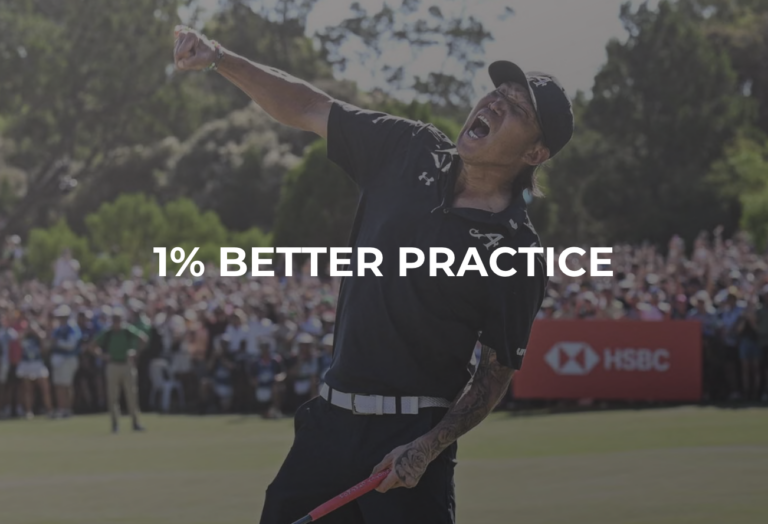
What Anthony Kim Can Teach Us About Getting 1% Better
If you follow golf news, you’ve probably seen the name Anthony Kim (AK) popping up everywhere lately. Back in the day, he was compared to Tiger Woods. He had a flawless swing and played super aggressive, but then he just walked away from the game.
He’s recently opened up about struggling with addiction during those years. I have so much respect for anyone who can face those demons and make it back to the top. That’s exactly what he did at the LIV tournament in Australia. He started the final round 5 shots behind guys like Bryson DeChambeau and Jon Rahm, then went out and didn’t miss a single shot.
I am always very curious about how the pros or high-level golfers spend their time practicing. AK has started a YouTube channel, and we can take a look at his range process. It’s actually something I am pretty familiar with because of how straightforward it is.
There’s a simplicity to his practice that I think some of us miss. He isn’t out there trying to reinvent the wheel every day; there is just a lot of attention to the small details.
These are my main takeaways from the video, but I really encourage you to watch it and see what stands out to you. Link at the bottom.
1. Your Foundation is Everything
Your setup is the base of your swing. If your setup is bad, every swing you take is basically just flipping a coin and hoping for the best. Your stance and alignment have to match the shot you’re trying to hit (draw or a fade). If the foundation is shaky, nothing else matters.
2. Don’t Be Afraid to Take a Step Back
I see so many golfers keep doing the same thing over and over, even though they aren’t getting better. They’re afraid to change because it might mean worse scores for a while. But to make a big push forward, you have to be okay with the frustration of the process.
If nothing changes, nothing changes.
3. Play with the Game You Have Today
Being able to score well with your “current” game is a SUPERPOWER. Whatever change you’re working on at the range usually takes a long time to show up on the course. In the meantime, hit the shot you know you can hit, not the “perfect” shot you think you’re supposed to hit.
4. Technique Practice vs. Performance Practice
When you’re on the course, you cannot be thinking about your swing mechanics. If you spend your whole practice session only thinking about “technical moves,” you won’t know how to actually be an athlete when it matters. If you have tournaments, the closer you get to that day, the more you need to stop fixing your swing and start focusing on performance.
5. Why Did You Hit a Bad Shot?
When you miss, do you know why? Usually, it’s not just a “bad swing.” It’s often because you zoned out, weren’t committed to the shot, or tried something way too difficult. Also, a quick tip: “I lifted my head” is almost never the real reason you messed up! Find your why…
6. Routine as Your Shield
Practicing your pre-shot routine until you can do it in your sleep is more important than having a perfect “pro” swing. Your routine is what keeps you grounded when the pressure kicks in. By using your imagination to create “make-or-break” moments on the range, you’re training your routine to hold up under stress. If you can trust your process on the range, you’ll be able to trust your game on the course.
The 1-Hour Practice Routine: Getting 1% Better Every Day.
Phase 1: The “Foundation” Check (15 Minutes)
Goal: Fix your alignment so you stop “flipping a coin” on every shot.
-
The Drill: Lay down two alignment sticks (one for your feet, one for the ball line).
-
The Work: Hit 15–20 easy wedge and 7-iron shots.
-
The Focus: Don’t think about your swing. Just make sure your feet, hips, and shoulders are perfectly parallel to the sticks.
Phase 2: The “1% Swing Change” (15 Minutes)
Goal: Focus on the ONE thing that actually helps your miss.
-
The Work: Pick the one drill your coach gave you or the one feel that stops your “big miss.”
-
The Focus: This is the only time in the hour you’re allowed to think about your “mechanics.” Do the move, see the result, and don’t worry about it looking pretty.
Phase 3: The “Performance” Switch (20 Minutes)
Goal: Stop being an “Architect” and start being an “Athlete.”
-
The Work: Pull the alignment sticks away. Pick a different target for every single shot.
-
The Focus: You are now in “Scoring Mode.” Go through your full pre-shot routine, visualize the flight, walk in, and commit.
-
The Rule: If you hit a bad shot, you can’t “fix” it on the next ball. You have to move to a new target. This teaches your brain to navigate the course with the swing you have right now.
Phase 4: The “Pressure” Finisher (10 Minutes)
Goal: Simulate the nerves of an important shot or tournament.
The Game: Play the first 3 holes of your favorite course in your head.
-
The Scenario: If the first hole is a Par 4, hit driver. If you “miss” the fairway, you have to hit a recovery shot. If you “hit” the fairway, hit an iron to the green.
-
The Penalty: If you don’t go through your full routine or if you lose focus, you have to start the “hole” over.
If you only have time for one thing, do Phase 1. AK said himself: “I didn’t know where I was aimed for two years.” Most amateurs are hitting “bad shots” that are actually just “perfect shots” aimed at the wrong place.
Happy Practice!